Interview 102 • Oct 25th 2026
- Interview by Lou Noble, Self-Portraits by Elizaveta Porodina
About Elizaveta Porodina
Renowned for elevating fashion photography to the realm of fine art, Elizaveta Porodina is the artist behind this decade’s most unforgettable collaborations, crafting iconic magazine covers and campaigns for luxury fashion houses and avant-garde labels. From her hypnotic images of Zendaya channeling Josephine Baker for Vogue Italia to glittering visions of Doechii as the love child of Diana Ross and Grace Jones for British Vogue, Porodina creates complexly layered, psychologically charged images in camera that have become instantly recognizable for her masterful manipulation of light, color, and composition.
Links
Foreword
With Elizaveta's new book coming out, we saw an excellent opportunity to speak with her about its production, which expanded into a larger discussion about process, work/life balance, where ideas come from. An artist who delves deep into the unconscious side of creating art, it made for a fantastic interview.
----
This interview has been edited for clarity and content.
Interview
I read some other interviews of yours. One of the things you said is that you’re not naturally pulled towards doing vacations. You like working.
I think that my entire life, I have fully identified with work. It’s only in the last couple of months that I started realizing that I’m actually a person, you know. Besides my functioning and productivity, I’m 39 now, and I think that it’s been literally like one and a half months since the realization dropped in that I’m worthy of existing even when I don’t deliver my best project yet.
Was there something that hit you with that lightning bolt, or was it a slow realization?
It was both. It was a slow realization, but I think that there was a cataclysmic event that led to it. I think I did experience a couple of things, like hardships in life, but also just a very surreal experience in nature. Me and my muse and my husband, we went to Norway and we experienced the midnight sun, and we were tripping, and I saw the universe. I saw the universe working, and I was so inspired by it, and I was so touched by it. I saw it basically reaching out to me, and I felt really compelled to look more inwards, rather than outwards, I felt compelled to go deeper within rather than constantly reach outward, because I feel like the outward is quickly understood if you’re intelligent, you get it quite quickly. But the mental landscape and the workings of your mind and the way of how everything is connected, they’re infinite.

The Return, Model: Cécile Paravina, From the exhibition, Fuerteventura by Elizaveta Porodina, May 2023
Now that you have this new perspective, is that going to change how you approach that work/non-work balance?
It’s hard to say, to be honest, because I do think that the old me and the new me both enjoy working. It’s more a question of whether you do it out of a place of running away from your demons, or whether you’re running towards something that you really think is beautiful, and you’re just a child with your eyes wide open and being euphoric and going like, “Oh my God, look at this! Look at this! I want to capture this!” I think that in both scenarios, she’s running. It’s just a question of whether it’s from something or towards something.
In the past, has there been an aspect of that in your work-life that wasn’t necessarily out of joy, but out of some…
I think I’ve always been very lucky with the nature of the work, and I always felt on a very intuitive level that the quality of work won’t hold up if I don’t truly connect to the source. In order for the work to be truthful and to be authentic and to feel like something that I like, it needs to not come from me. Essentially, it needs to come from everywhere. I need to channel it, and I’ve always known that, since I was a little kid. I always felt that my best things and the best words and the best pictures and my best…when you write, your best writing happens quickly and effortlessly sometimes, and it doesn’t feel like you’re writing. It feels like someone something is writing you. And same for photography and same for these setups.
When you work with a team and everything flows, everyone almost communicates telepathically to each other. You don’t even need to say things. People know what you want from them from a certain point on. Everyone feels the concentration, and I’ve always felt that since I first made art, and I think that always protected me from ever spoiling my work by being purely productive.
When you’re working on set, is there a certain process you go through so that you can become that kind of conduit, so that you can put yourself in that headspace?
There is no ritual. No one is holding hands or playing the flute. There is nothing like that. I do feel like it is important for me to verbalize what I’m feeling, to put in words all the amount of gratitude, kindness, and the specific, precise, clear idea that I see in my head, to really say it with conviction, to say it with emotion, say it with intention to every single person on set. I go from station to station. I do collect people and I explain the idea, and I try to make sure that everyone is on board with it, intrinsically.
I do think that it’s important to be enthusiastic about it in a very authentic way. You really need to inspire people, and you need to make sure that they find enough space to convey their way of doing things, that there is enough space for people to be collaborative and to bring their ideas. Because I do believe that the best ideas will come from everyone, not just from, you know, my amazing genius self. So that’s what I do.
And with regards to the book, what kind of feeling did you want the audience to get going through, as they experienced it?
The book is basically a retrospective of my process for the last four years, which has been a very focused, very concentrated, very convicted aspiration towards trying to capture this feeling of being out and in balance with your body, trying to find the connections between body and mind, body and soul, question it, and all that while being in the frame of someone who is called woman occasionally, which is in our society, a very surreal experience in itself.
Yeah.
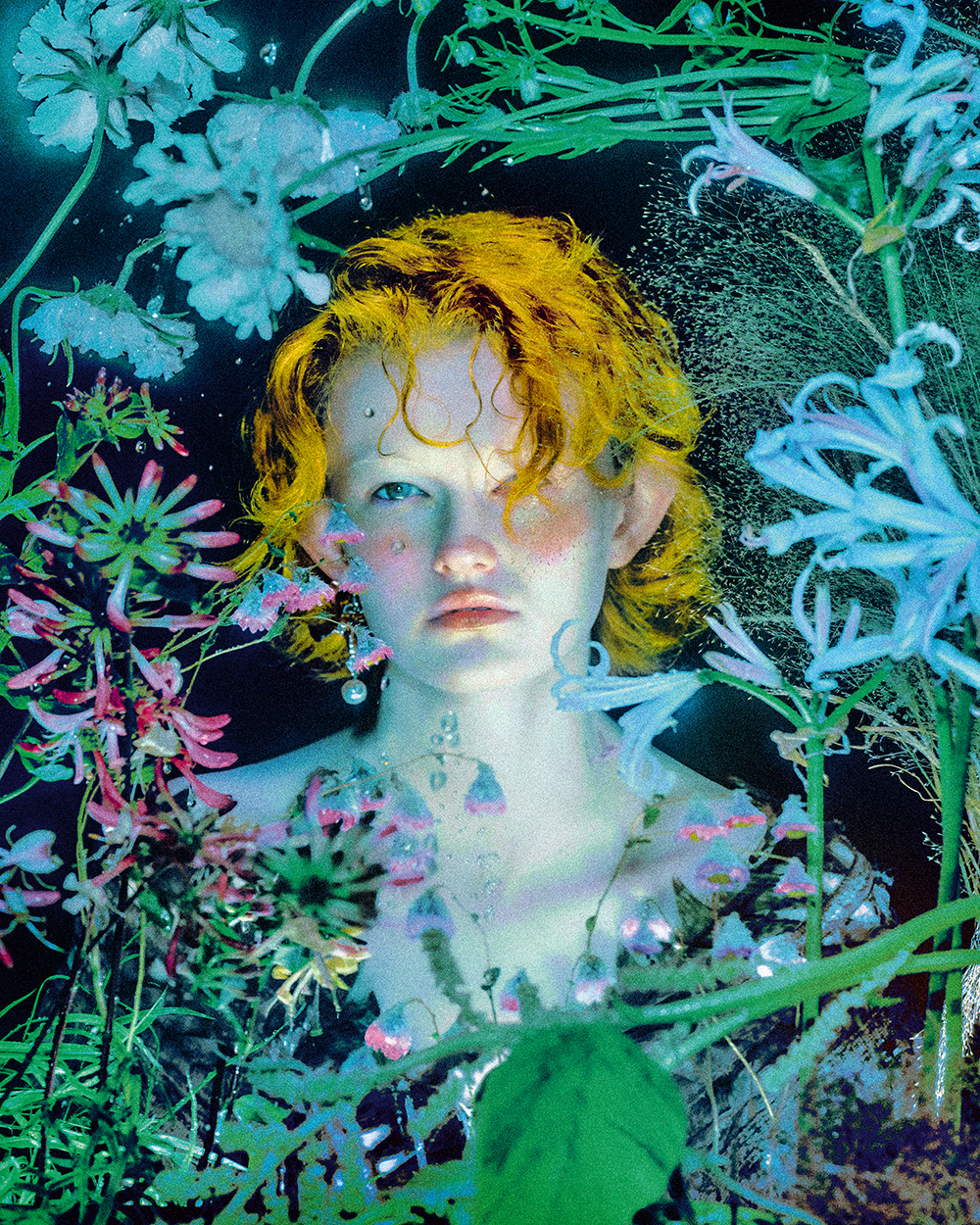
The Magical Dream, Model: Aimee Byrne, Featured in: Atmos, November 2025
I’m not saying this is about female gaze at all, because on some days I’m not sure if I would call myself that. And I wouldn’t say it is about just dreams, even though the book is called “Found Dreams”, and it is structurally about a person descending from reality into the hypnagogic state, and then further on into the REM state, where you experience almost hallucination-like dreams, very creative dreams, very like gravity-less dreams, and then going further up and being with it, and being renewed by this dream, being within the knowing of what you have found in the dream, but finding yourself back in your reality again. It is about both of these things and more.
It is about feeling sometimes how life is questioning reality, questioning the borders between dreams and reality, while finding yourself in that specific type of body. Also, just exploring the idea of what it means for a soul to be within a body on this earth right now.
Did you did you know that going in? That that’s what you wanted to explore?
All my work is about that. So in the last couple of years, it was what I was trying to figure out. Like there is a word that you cannot find, and you keep approaching the word from different angles, almost describing the negative space around the word. So the whole book is, to me, almost this torturous exploration of what the fuck is happening to me? Why does it feel like that?
Were you able to find answers through the making of the book?
I do feel like for many years I’ve been at a ceiling in that sense, where I was, it was almost like a veil, a glass ceiling of a certain elevation that I was tapping against, feeling confused at times, feeling lost, feeling like the boundaries of reality, he boundaries of dream are frustrating, and the boundaries of the soul are frustrating, and the boundaries of my knowledge are frustrating, and it feels torturous and and itchy. And it did feel cathartic to do the book, to do the work for it, to go over it again and again. Almost like an obsession with different subjects, asking them all the same questions again and again, and receiving a multitude of answers from bodies, receiving a multitude of answers from souls, while pulling them into my world and my itchy, torturous fascination, and by that receiving something like a common denominator,.
It’s sounds like a very challenging way to engage with your art, because there can be that frustrating aspect.
Fuck yes! Thank you for saying that.

The Magical Dream, Model: Awek Gak, Featured in: OD Beauty, February 2026
If you can have that catharsis, great. But if that catharsis is interrupted or frustrated, you’re not getting what you want. It must be even harder than someone just going out to take a pretty picture.
What I’m hearing you describe is that every photo session is a journey that you’re going through, and that the creation of the book was not only a journey in and of itself, but also an attempt to take the viewer on a journey.
Totally, and it is 100% a journey. And because dreams are not linear, certain contents within it are also not linear, and they take you to unexpected places. While there is still, I would say, a trajectory of the descent, and then coming back up again. So there is a sort of like a Marianas Trench. It’s really taking people to the deepest points of it.
I think dreaming can be that for sure, and I just feel like when people are speaking about dreams or people are reflecting on dreams, it cannot be overstated enough how absolutely taboo-breaking it sometimes is to dream, and that it does take you sometimes to your own personal hell. It does take you to this underworld, to the shadow side of yourself. And this is another thing that I cannot stop exploring, and that I get obsessed by. That every human that walks the earth has a part of themselves that they like to put light on, and then there is another part that they either don’t even know about, or that they deliberately hide from the other people because they feel like it’s shameful, and then it grows on to be something very potent.
And I feel like tapping into that in the photo sessions, and within the book was something that felt essential too.
Is it more difficult because you’ve got this blend of people who are famous and people who are not…do you find that it’s more difficult to take a celebrity into that space?
I don’t. Because I don’t have a conviction of taking them somewhere. If I came to the shoot and I was like, “Girl, today we’re going to like my hell. This is what we’re supposed to do. This is how you’re supposed to act,” I picture that going both ways. You could meet someone who’s potentially interested in that journey, and you could meet someone who would be like, “No, I have different things going on. I’m not interested in that exploration.” Instead, I outline the journey by certain objects, or environments that can be interpreted in vastly different ways.
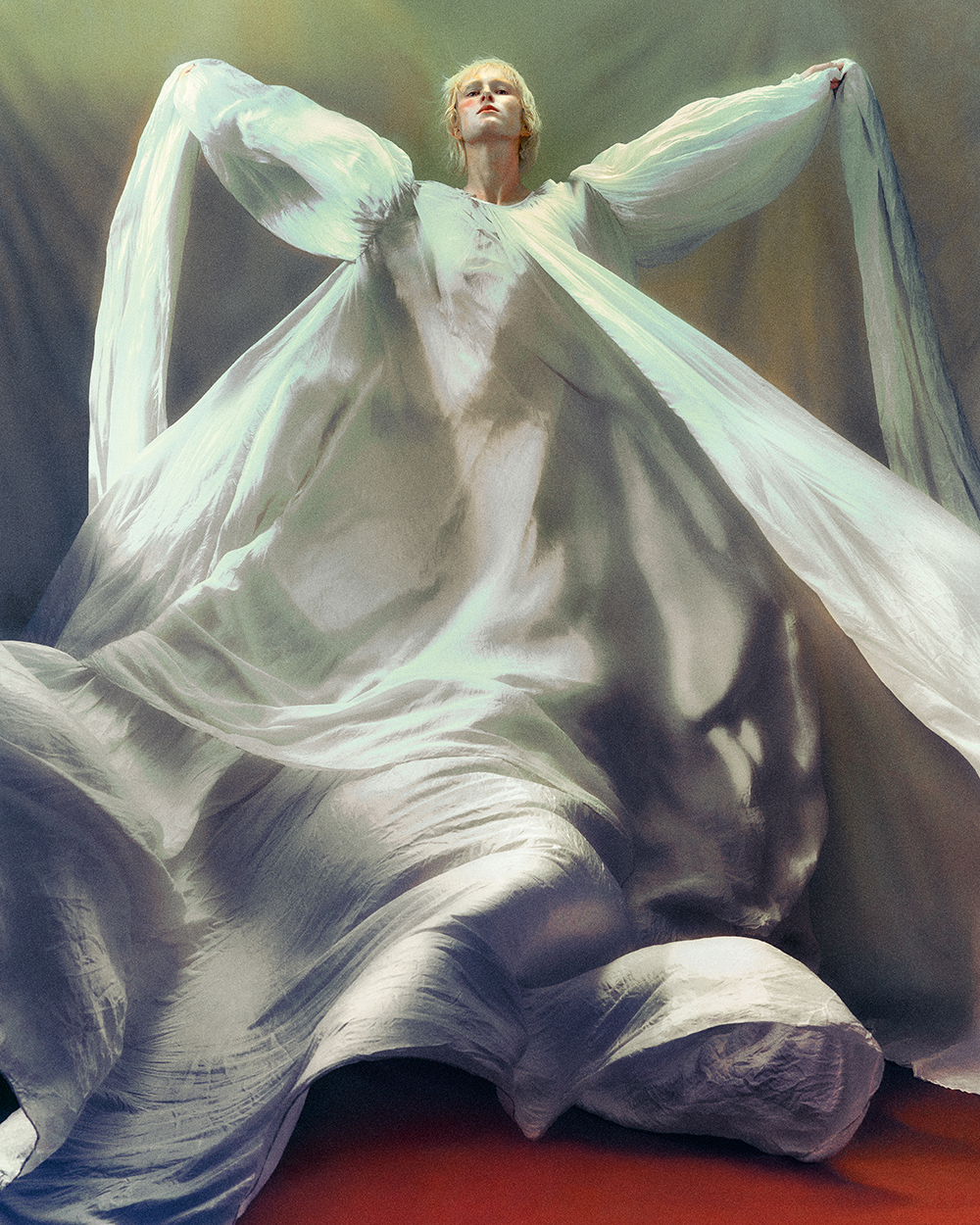
The Return, Model: Britt Liberg
I want people, through choreography, through me, almost hypnotically clicking, with me saying certain affirmative things during the shoot, but also corrective things in a way to do this journey in a place that is unknown to both of us. I don’t want to show anything that I already know. I think that would be very boring, and I don’t want them to just simply execute what they have already exercised many, many times. I think it needs to be a place that we discover together. And the only difficulty that I would ever encounter is to have someone on set who doesn’t want to explore.
That rarely happens because I feel like my pictures, if they signal anything to people at all, is that this is going to be a trip, you know. And if you don’t want to go on this trip, you already know that beforehand.
Right, right. They would have chosen someone else.
100% and they do. You know, they do. So it’s very straightforward, actually.
With the book, were there any surprises in how you were putting things together and what you were seeing from your own older work?
So many. It’s amazing to edit a book with someone who you know in this very deep way. The editor has already worked with me on my previous book, and that felt like coming back to a familiar environment, but at the same time working with her, seeing her viewing the material in this different way with fresh eyes. She was putting things together story-wise that I didn’t really think of, which would then compel me to answer to that in that style, but also with a way how she wouldn’t have seen it.
And so we realized that there would be pairings that almost felt like the shadow and the light side, the negative and the positive of certain things, and finding very similar motives within shoots that felt completely like polar opposites to each other. Like we were excavating archetypes within my work, which felt so exciting because this is what all my work is about-excavation. And so every time I would discover, you know, my interpretation of the shadow, my interpretation of the mother, my interpretation of the beast, I would be like, “Oh my God, wow, that is so fucking cool! That’s what art-making is about.” This it’s about being this child who is being surprised by what they’ve done.
It sounds like you were getting a similar feeling making the book that you do in making your art.
That’s exactly it. When I have a shoot where I don’t get this surprise feeling, I sometimes go home and I’m like, “I flunked it.” Like I messed it up. And it’s not it’s not necessarily true. To be honest, it’s rarely how I think about it in that moment. But I am sort I’m addicted to that feeling. I’m addicted to the feeling of finding this gem rather than putting it together myself.
That flow state, right? Where there’s what you know and and what you’re good at, but then you hit this different level that’s about something that is new and unique, and that those two merging…
It’s exactly that. You do ideally start at a point that feels sort of comfortable-ish, right? It might be lighting or an environment or an object, but then you want the person to find a relationship to the object that feels like theirs. We were working for Pop Magazine, where we’re doing a shoot with Jesse Buckley, who is obviously this insanely talented artist and actress. I cannot overstate enough, yes, she’s an actress, but she’s also powerful idea-generating engine. She’s someone who looks at the work deeply, and within seconds, while she’s looking at the pictures that are incoming, she analyzes them on a very deep level, on the relationship level between person, object, person, environment.
But she also feels deeply, so it’s hard for me to really go into the workings of her mind and of her soul, but what I have experienced is someone so deeply in touch with their intuition and their artistic engine.
Yeah.
And when I gave her the needle that we 3D printed from some translucent material, and she started making the movements, it was almost like she was sowing a new identity, a new personification of herself. And I didn’t know what she was gonna do, but the picture feels like she’s the creator, it feels so assertive, so confident, and at the same time, so bold and so childlike and so deeply unlearned, and it was so inspiring to me to see that. And this picture stand out to me when I think about what I was trying to convey. I didn’t know what she would what she would do with it, and the way how she did it was so inspiring to me. I will never forget it.

Model: Jessie Buckley, Featured in: POP Magazine, March 2026
One of the few aspects that don’t necessarily come across in the work is how much your subject is contributing…as the viewer, my assumption is that you are the composer and ultimate architect of everything, but what you’re telling me is that there’s so much collaboration in your work.
There is so much collaboration, and I would never want it any other way. And in fact, I would want more collaboration. What I would want ideally is for us both or everyone to just be there and let the work happen, because we’re doing the exactly right steps. Because I do think that real art-making is about getting out of your own way, not being so cocky about your cool ideas.
The older I get and the more experienced I get, the more I understand that whatever you think you’re coming up with is just a good starter, right? They’re all just starters for something that is much more like something that you cannot even imagine, and you need to become the collaborator with this unknown.
Yeah, you have to let your ego recede.
Yeah, the ego needs to shut up once in a while.
Were these things you were exploring when you first got into photography? Was this something you had to discover along the way?
I studied psychology before I got into photography, so a lot of this knowledge was privy to me on the intellectual level, which I can assure you doesn’t mean that any of it trickled into my actual life. I was happily preserved from any application of my own amazing knowledge onto my own life, and all of these things I’ve heard before. So I continued being what I am and exercising all the bad habits that I have.
But curiously, I want to say that the reason I think I was so compelled to get into art and make art is because I always intuitively felt that when I’m making art, this type of work always takes me one step closer to being a better version of myself. Because the work happens so much on an intuitive level and so much with others, somehow these days on set always made me behave so that I would go on the intuitive level rather than try to force people. Since I started shooting, I always was on the better side of my communication, on the better side of my habits, on the better side of my endurance or resilience.
It was bringing out the best in you.
Yes, that’s what I’m saying. I was like the plant, sort of stretching towards the sun. It was very, very much a no-brainer. “This is the good stuff. You want to go there, not towards your depression.”
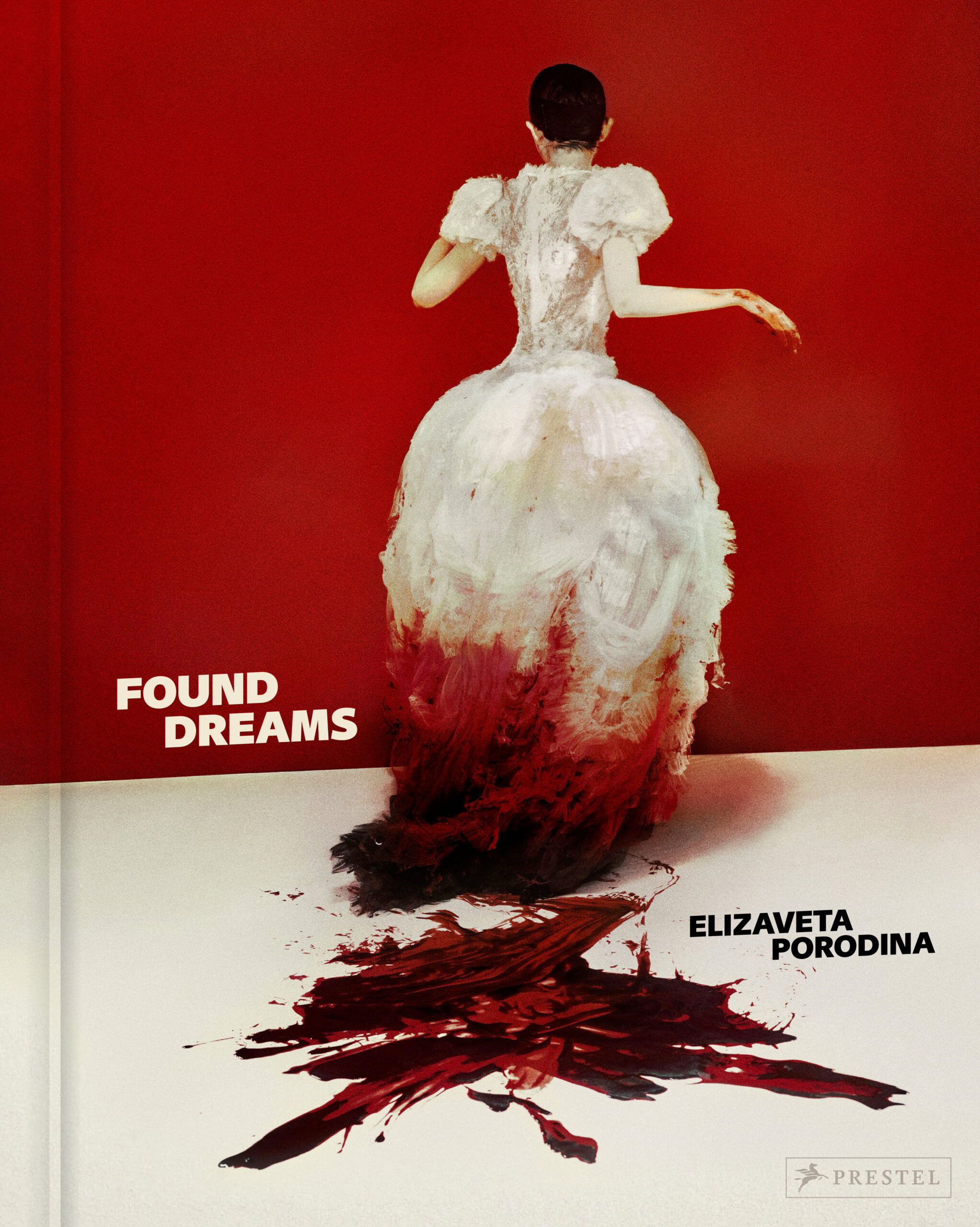
Elizaveta Porodina: Found Dreams edited by Nadine Barth and Elizaveta Porodina © 2026 Prestel Publishing
How do you feel about the book now that it’s finished? Do you feel like you were able to get that journey where you want it?
In that sense, I’m a very happy person, As in, I think that if I manage to create something that feels like a coherent journey, then I’m happy with it. I don’t go somewhere being like, “oh, this is exactly what this is gonna be, and if it’s not exactly like that, that I’m gonna murder everyone.” I knew that it needs to convey this idea of a tightrope dancer between life and death, shadow and life, body and not body, being alive and not being alive, all of these sorts of opposites or maybe not opposites. And I do think that this is in the book, so I’m quite pleased with myself.
Now that you’ve completed the book, do you want to go in a different direction?
There have never been clear paths where I was like, “and now I’m just going to explore street photography.” It’s way more like an organic continuation of a topic. For example, when I was talking about people shamefully hiding certain parts of themselves. Like right now, this is where my brain is focusing and zeroing in on this specific embodiment, and this is what I’m gonna be working on for the next couple of months to a year-I don’t know-but this is what I’m currently obsessed by. But this feels very organic, and it feels like it could be both something very distinct, but also an organic continuation of what you see in the book. More looking into what people are trying to conceal, more work on examining people’s shadow.
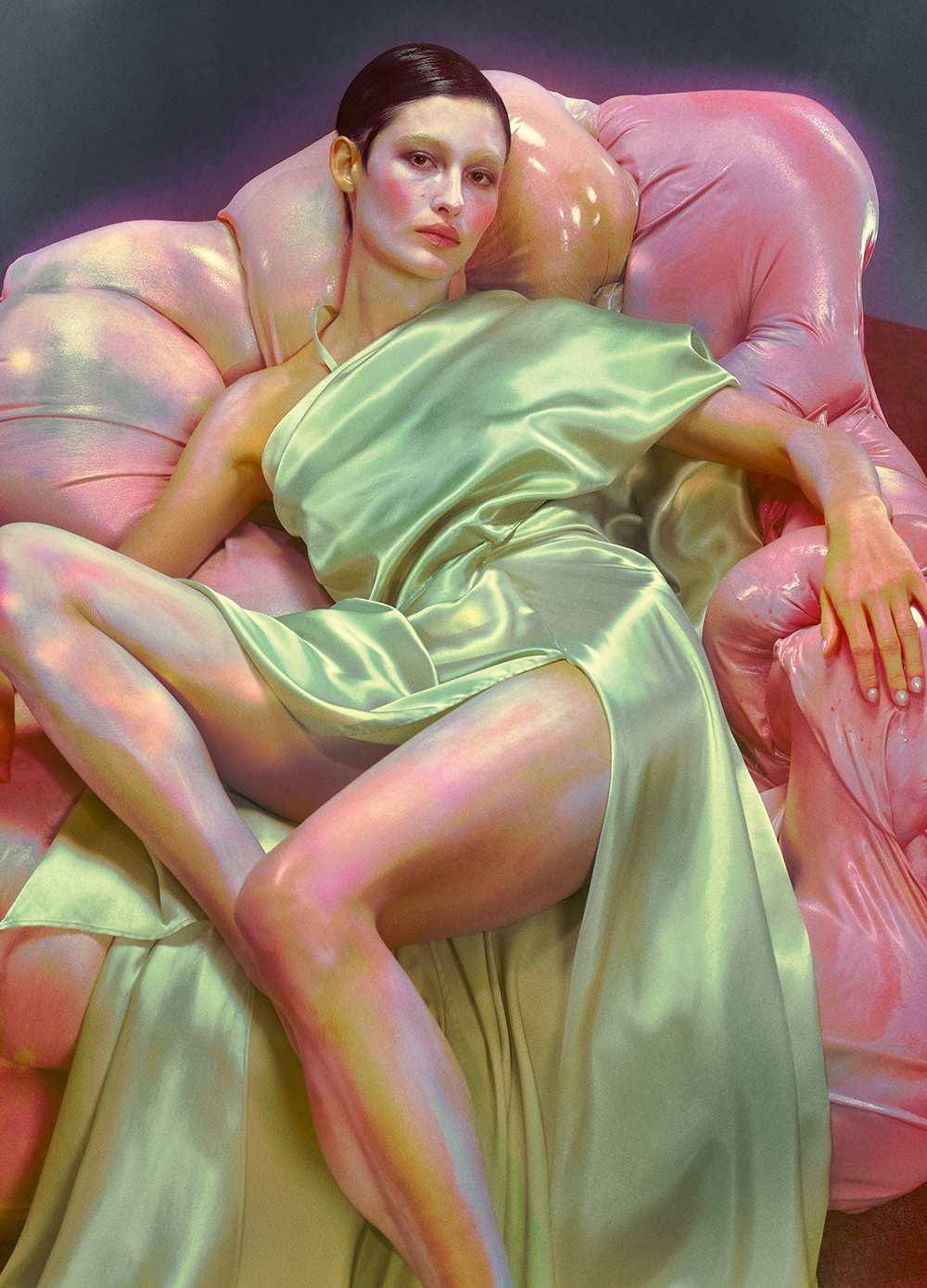
The Dreaming Body, Model: Grace Elizabeth, Featured in: Vogue China, June 2023
For you, do you prefer the process or the finished image?
It depends. I would say this differs from project to project. Sometimes I nail my own taste, and then I just dig the finished product, and I’m looking at the images, and I’m like, “yeah, this is exactly to my liking.” But a lot of times I will do something, and the process felt interesting or challenging or whatever, and I will shoot something that feels more complex to me. But then I will experience other people interacting with it, and that is something that is also very interesting to me.
With your artistic practice being such a core part of you, is there any tension doing it as a profession?
First of all, I got into it after already having a career that I didn’t like, didn’t find myself fulfilled in. Yeah. So I was like, “if I do another thing where I’m not gonna be happy, what am I doing here?” Mind you, I was entering photography with zero means, zero connections, zero relationships, zero financial support from whoever. I’m not a nepo baby. I’m not rich or anything like that. So there was nothing like that. I was very delusional about what I can achieve, and very like, “yeah, I guess I’m just gonna do it.” And I think that I found a couple of mantras that worked out for me really well. Like if a client wants to work with me, they buy my time but not my soul and not my integrity.
Yeah.
So it’s access to me or my ideas or my way of interpreting things, but it’s not necessarily my entire self.
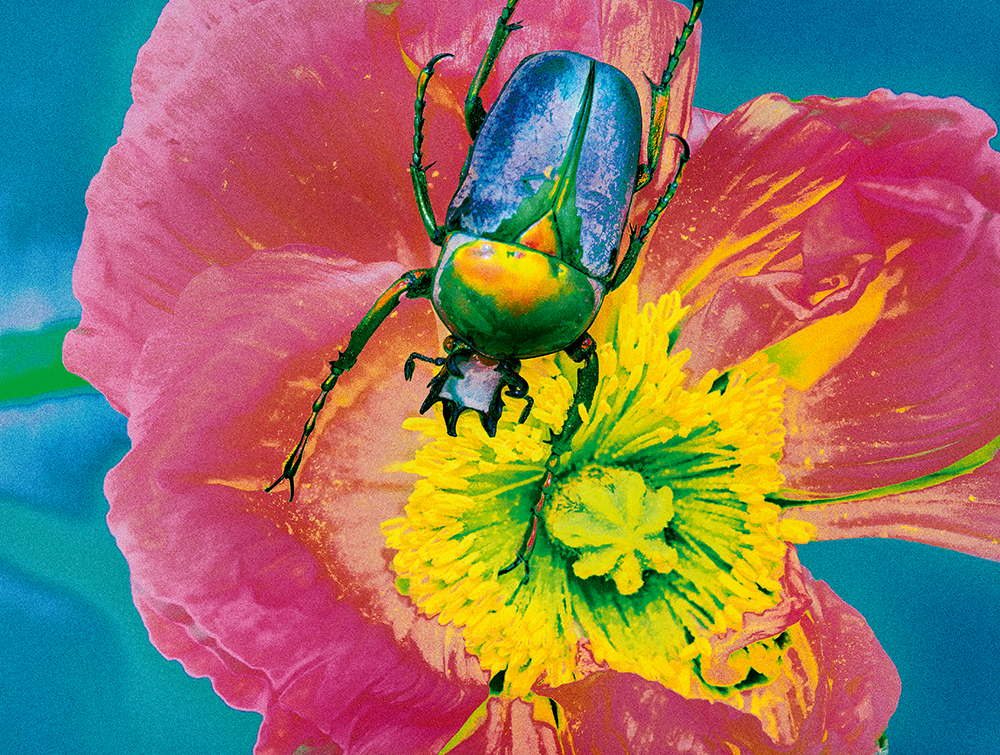
The Magical Dream, Featured in: Atmos, May 2025