Interview 097 • Jan 12th 2026
- Interview by Agustin Sanchez
- Portrait of David LaChapelle by Agustin Sanchez
About David LaChapelle
David LaChapelle is an American photographer and director whose work has played a defining role in shaping contemporary visual culture since the late 1980s. After being discovered by Andy Warhol and hired to work at Interview magazine, LaChapelle quickly became known for his hyper-saturated, theatrically staged photographs that bridged fashion, celebrity portraiture, and fine art.
Over the course of his career, his work has appeared in major international publications and been exhibited in museums and galleries worldwide. While his early images were often associated with pop excess and celebrity culture, LaChapelle’s practice has increasingly turned toward themes of faith, environmental anxiety, consumerism, and spiritual reckoning. His later works reflect a sustained interest in mythology, religious iconography, and the tension between spectacle and belief.
Across four decades, LaChapelle has remained committed to collaborative, labor-intensive image-making—building physical sets, painting negatives, and working with artisans whose crafts are increasingly rare. His work continues to challenge distinctions between commercial and fine art photography, insisting on the photograph as both a constructed object and a cultural mirror.
Links
Foreword
David LaChapelle’s images are immediately recognizable: saturated, theatrical, meticulously staged, and unapologetically maximal. Emerging from the worlds of fashion magazines, pop culture, and Interview magazine under the mentorship of Andy Warhol, he has spent decades collapsing the boundaries between commercial photography, fine art, and spectacle. Beneath the surface excess lies a sustained engagement with belief systems—faith, capitalism, celebrity, environmental collapse, and the human appetite for meaning.
In recent years, those concerns have come into sharper focus. Environmental works sit alongside spiritual allegories, hand-painted negatives converse with large-scale constructed tableaus, and humor gives way to grief, anxiety, and uneasy reflection. At a moment when photography is increasingly flattened into screens, prompts, and simulations, LaChapelle continues to insist on the physical act of making images—building sets by hand, painting skies, lighting performers, and photographing scenes that exist in space and time.
I met LaChapelle surrounded by this body of work, and our conversation unfolded less like a formal interview than a sustained meditation on craft, collaboration, authorship, and survival. We spoke about analog processes in a digital age, the labor behind his most ambitious images, the role of collaboration in his studio, and how his relationship to work, faith, and balance has shifted over time.
----
This interview has been edited for clarity and content.
Interview
I want to start broadly. You’ve lived through several major shifts in photography — cultural, technological, economic. When you look back at when you first started, what feels most different to you about the world when you entered versus the one you’re working in now?
Yeah. My heroes. Avedon started young, like me, working within magazines — Hearst, Condé Nast, advertising — and he died under that same system. That mattered to me when I was young, seeing that path, seeing that you could live your whole life inside photography.
Photography has changed so dramatically since I started taking pictures. First it was analog. Then Photoshop arrived. And then the internet really, really took over. I remember when people talked about what was in Vanity Fair. People actually talked about it. There were contracts — real contracts. Rolling Stone, Condé Nast Traveler — there were budgets, there was time, there was space to make things.
That entire ecosystem doesn’t really exist anymore. So I’m just grateful to still be working, honestly. And with all that change, the most important thing for me was learning how to evolve instead of fighting it. But at the same time, I’ve tried very hard to hold on to my belief in an analog vision.
People look at the work now and assume it’s AI or digitally assembled, but it isn’t. I used to hate behind-the-scenes images. I really hated them. I felt like they gave away the magic. But now I shoot behind the scenes for everything, because I want there to be proof. Proof that these images were built, not put together later on a computer.
David LaChapelle
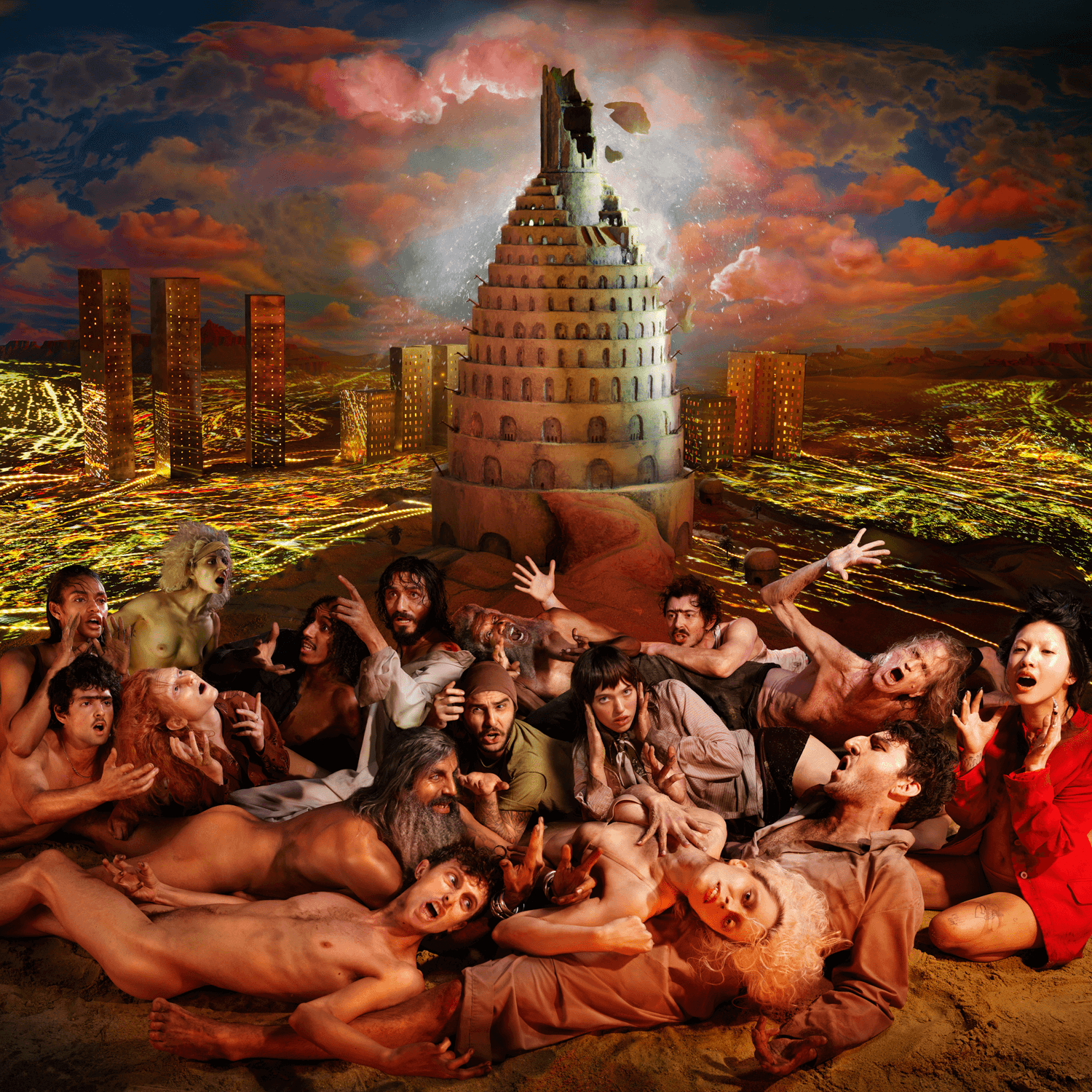
Tower of Babel
Los Angeles, 2024
Pigment Print
When you say “built,” what does that actually look like for you? Why does it matter that people understand that process?
Because I believe in what I do. I really do. And the work is theatrical — it takes a lot of skill from a lot of people. Builders. Painters. Projectionists. Set designers. Lighting people. All of it.
To take all of that labor and collapse it into one digital author just isn’t fair. The credit belongs to the people who actually built these things. The Tower of Babel still sits in my studio. It’s physically there. The sky is airbrushed — that’s a dying art. I’ve worked with maybe three airbrush artists in my entire career. You just don’t find that anymore.
Those backgrounds — the airbrush painting, the lighting — those are real crafts. In the seventies there were lots of airbrush artists. Now it’s almost gone. So when someone says, “Oh, that’s just digital,” it erases the people who made it.
Those backgrounds — the airbrush painting, the lighting — those are crafts that are disappearing. To call that a digital composite erases the labor of the people who made it.
David LaChapelle
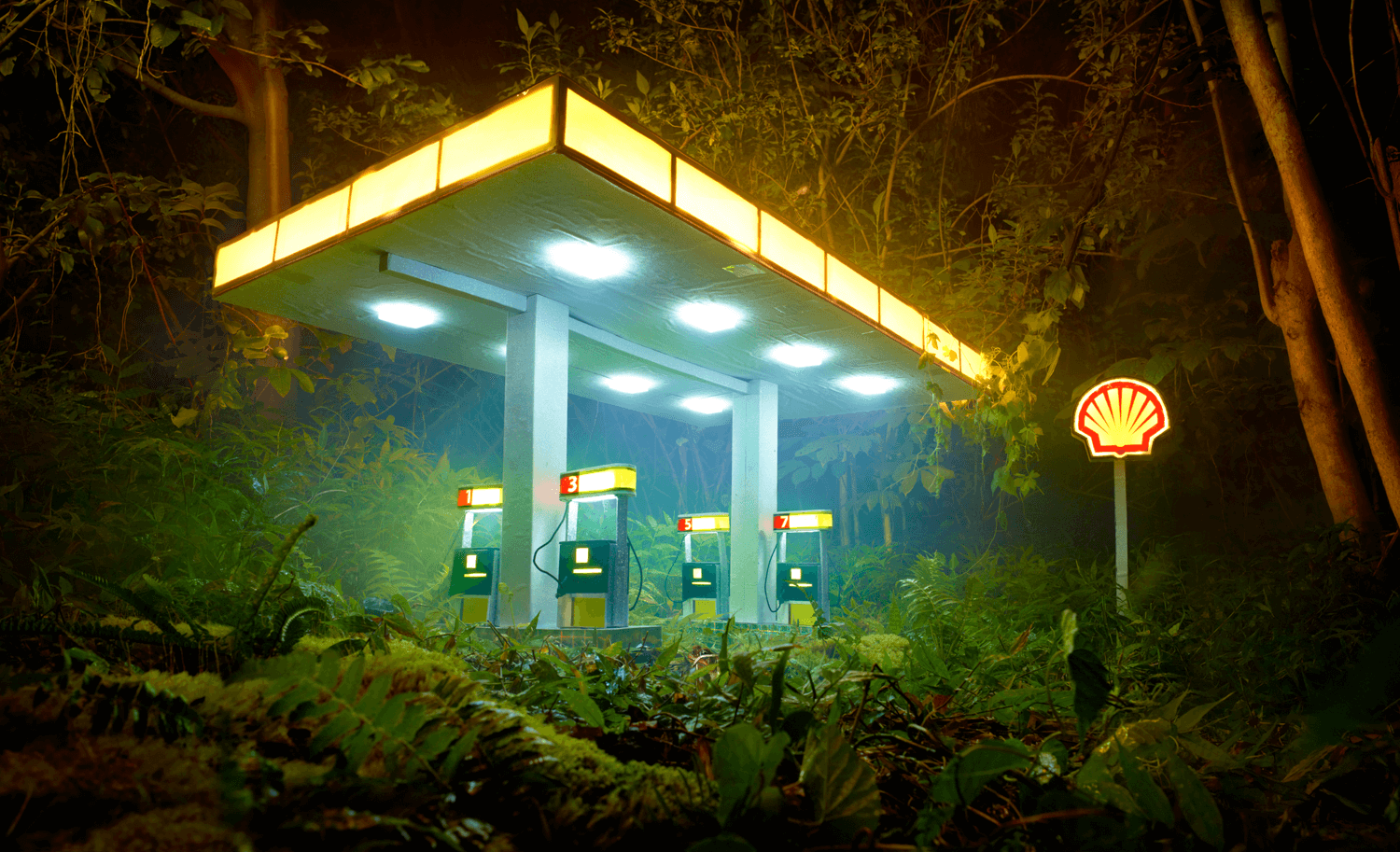
Gas Shell
Hawaii, 2012
Chromogenic Print
Collaboration feels inseparable from how you work.
Completely. I want to see the tableaus exist in front of me. I’m not a computer guy. I want to see the sets, the costumes, the lighting, the casting — all of it.
There’s an adrenaline rush to that. It’s theatrical. Opening night is the shoot. The flashes go off. I cast a lot of dancers because they’re very free with their bodies. When we’re done, people cheer. It really feels like a performance.
I dream about being on sets all the time. Either I’m on a photo shoot, or I’m apartment hunting in New York. Those are my two recurring dreams.
Apartments in New York were ecstatic and traumatic at the same time. I got my first squat when I was sixteen, on Third Street between Avenue A and B in 1979. Later, I subleased it to a friend who kept it from me. People were ruthless about apartments.
I still have dreams about that — and about being on set.
Do you still carry that energy once the image is finished?
I’m addicted to that feeling during the shoot. Completely addicted. But once it’s done, I don’t really think about the process anymore unless I’m explaining it. Then it becomes about the composition. About printing.
Printing is extremely important to me. I spent twelve years printing — six years black and white, six years color. Those were the “dark” ages of my life. I was either in a darkroom, a nightclub, or a photo studio. Sometimes I never saw the light of day. Now everything comes through my studio. I oversee all the prints. I still print my own work.
We have a framer in New York and a framer in Berlin — those are the only two we work with.
What the work says is as important as how it looks. Clarity of meaning is essential — especially in works like Negative Currency, where value, material, and image are inseparable.

David LaChapelle
Devon Aoki: Spaghetti Drama
London, 1998
Pigment Print
You mentioned AI earlier before we started recording. I’d love to go back there for a moment.
I mean, artificial intelligence exists. I don’t know about artificial creativity. AI can pull from other things, but imagination is different. I look at some pictures I’ve made and you’d never know where the influences came from unless I told you.
Take Spaghetti Drama. The top part reminds people of Eggleston’s red room. The bottom comes from Magical Mystery Tour — that scene where the women are stirring a giant pot of spaghetti.
I wasn’t consciously thinking about either of those. Those images were just stored in me from childhood. They come out intuitively.
That feels closer to memory than quotation.
Exactly. And that’s why behind-the-scenes images matter now. People need proof that these things existed in time. If they were illustrations, I wouldn’t be ashamed of that — but they’re not. They existed. They were built. I photographed them.
Let’s come back to Tower of Babel.
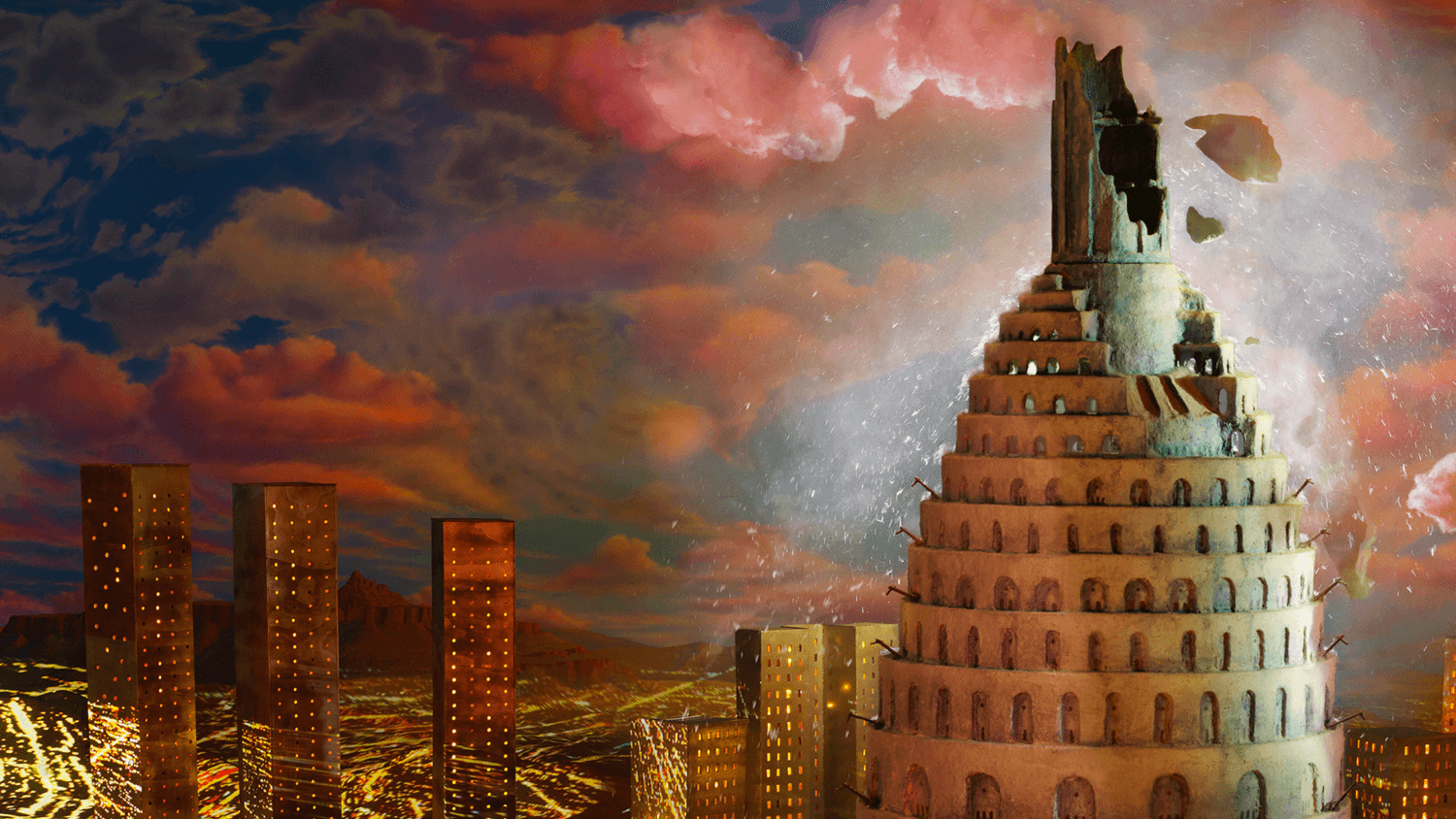
It’s about what’s happening right now. Everyone is talking. No one is listening. Everyone has a platform — podcasts, comments, opinions — but there’s no empathy. Even within groups that supposedly agree, people are divided. It feels like we can’t understand each other anymore.
David LaChapelle
Tower of Babel (detail)
Los Angeles, 2024
Pigment Print
You’ve spoken about education and learning how to think.
I thought college was a place where you heard different opinions and then made up your own mind. I didn’t think it was a place to be indoctrinated. I dropped out of high school at fifteen. I was truant, living and working in New York, but I kept drawing and painting.
I got accepted to the North Carolina School of the Arts based on my drawings. That was a huge break for me. That’s where I learned photography. Photography scared me at first — all those numbers. I was terrible at math.
But I realized how intuitive it was. The lens is like the eye. The darkroom became intuitive. I did wild experiments — painting on negatives, reversing colors. Once I picked up a camera, I never finished another drawing.
You learned collaboration early on.
Working for Andy Warhol at Interview was huge. Andy asked everyone their opinion — interns included.
That stayed with me. I remember asking interns which print they preferred. Sometimes you want a fresh eye — someone without technical training — to tell you what feels right. That openness makes the work better.
Photography is collaborative by nature. Some artists don’t want that, and that’s valid. Someone like Nan Goldin is documenting her life. That’s different. What I do requires many voices.
David LaChapelle
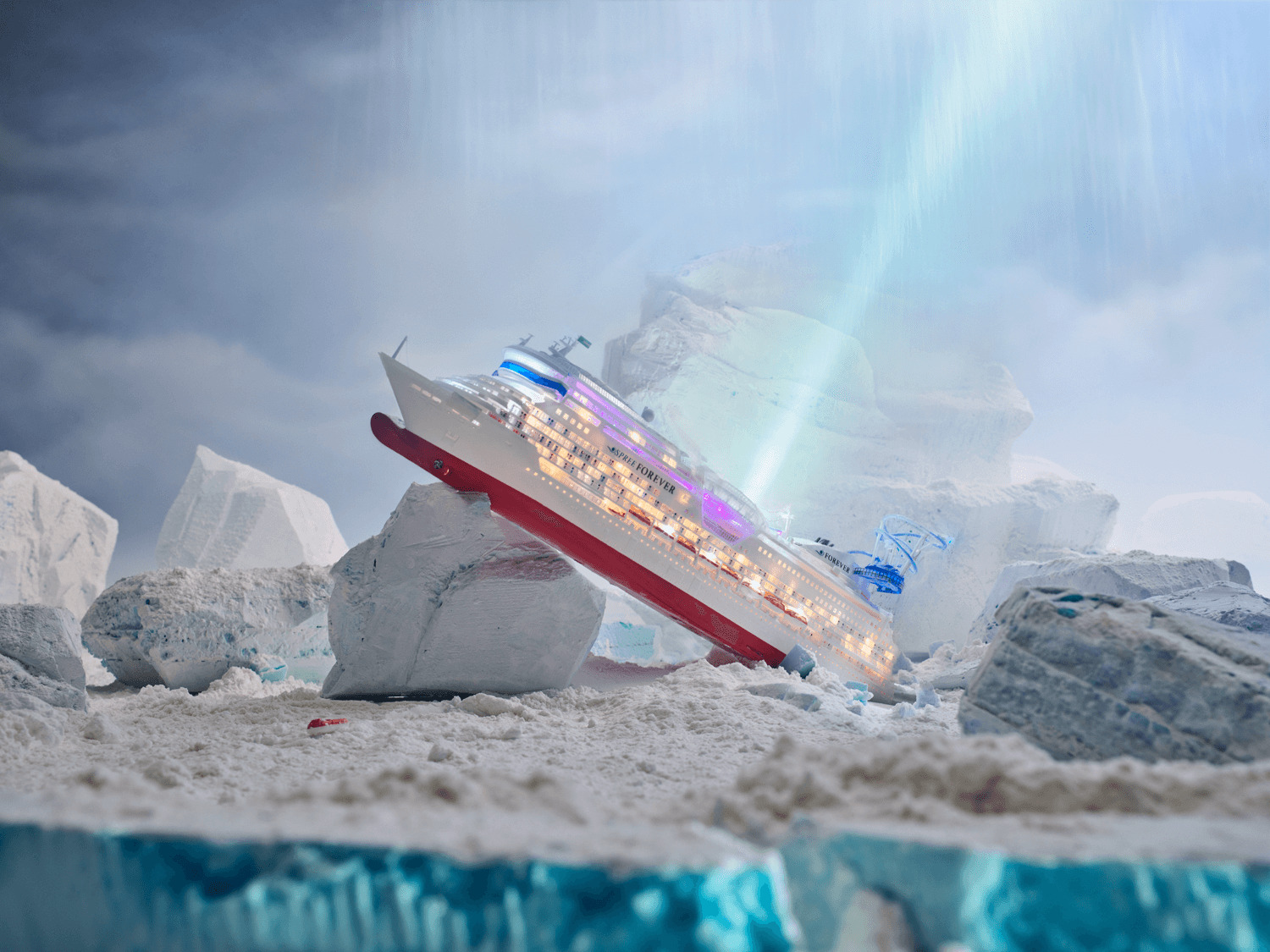
Will the World End in Fire,
Will the World End in Ice
Los Angeles, 2025
Pigment Print
Climate and spirituality run through a lot of the work.
Climate change has been on my radar for over thirty years — work like Gas and Land SCAPE came directly out of that awareness.
Biblically, after the flood, the promise was that water wouldn’t end the world again. So the opposite would be fire. We’re living like nothing’s wrong, but it feels like a different chapter now. Multiple existential threats at once.
There’s also a turn toward balance.
I went through a very dark period. For Men Will Be Lovers of Self & The Sorrows came from that. I was a workaholic for twenty years. I had rules — I always needed a cover, something in the top ten on TRL, something on VH1. Work was my safe place. Like an addiction.
Eventually I needed balance. I found a place in Maui — an old abandoned nudist colony — and turned it into an off-the-grid farm. I went back to painting on negatives — works like BeHold and Golden Sabine. Some are from the eighties, some are recent. It’s all connected.
David LaChapelle

David LaChapelle
For Men Will Be Lovers of Self
Los Angeles, 2021
Pigment Print
The Sorrows
Los Angeles, 2021
Pigment Print
This exhibition spans decades. What do you hope people take away?
Not every image needs to be deep. Life has a shallow end and a deep end. Humor, escapism, fashion — they all belong. The celebrity work brings young people into museums. Then they see work that can’t exist on a phone screen. I don’t separate it anymore. It’s all one body of work.
I can’t think of a better note to end on. Thank you so much David.
Thank you. It was a great conversation.
⁂
David LaChapelle — Vanishing Act
VISU Contemporary, Miami Beach
29 November 2025 – 31 January 2026
Vanishing Act brings together more than 30 works spanning four decades of David LaChapelle’s career, including the world premiere of nine new pieces. The exhibition traces the evolution of his practice from early pop-cultural spectacle to later works concerned with environmental collapse, spirituality, and the fragility of contemporary belief systems. Large-scale constructed tableaus appear alongside hand-painted negatives and intimate allegorical works, emphasizing LaChapelle’s continued commitment to physical craft and analog image-making in an increasingly simulated visual culture.